
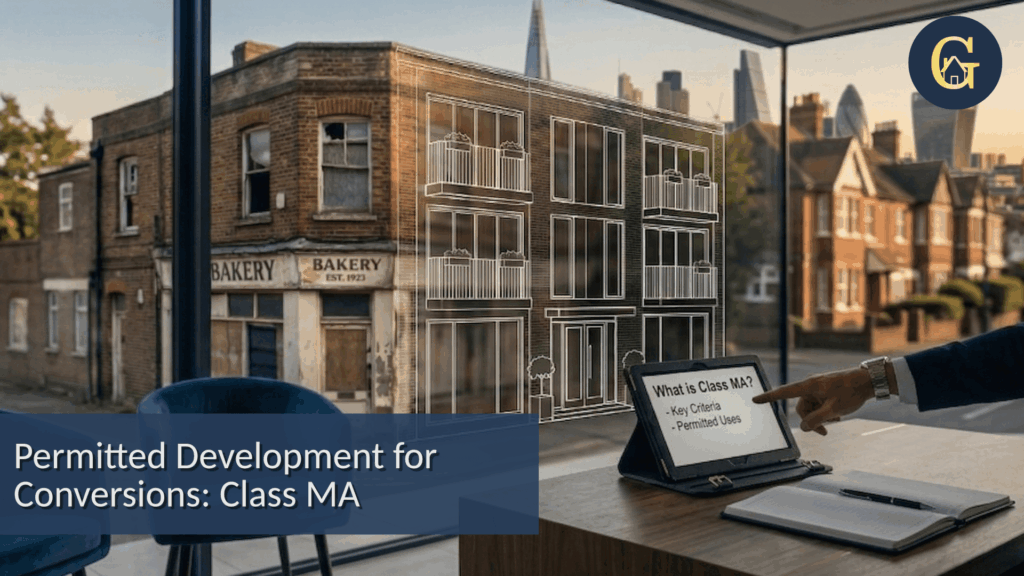
Introduced to simplify property development, Class MA permitted development allows certain commercial buildings to be converted into residential units without going through full planning permission. It can be a shortcut to profit but only if you understand the rules.
At GoldHouse, we help investors and developers across the UK and Dubai structure their projects smartly from day one. Let’s break down what Class MA really means, how it compares to other routes, and how to avoid expensive mistakes.
What Class MA Means and Where It Applies
Class MA is a permitted development right in England introduced in 2021. It allows the change of use from Class E (commercial), including shops, offices, gyms and clinics – into Class C3 (residential) without needing full planning permission.
It’s designed to breathe life into underused high streets and commercial districts while easing the housing shortage. For developers, it means fewer delays, reduced red tape, and lower upfront costs, as long as the site qualifies.
Projects under Class MA still require prior approval from the local authority, but it’s a far more streamlined process than a full planning application.
How Class MA Compares to Class G and M
Before Class MA came into force in August 2021, developers had to rely on narrower permitted development rights like Class M and Class G:
- Class M: Allows conversion of certain retail units (formerly Use Class A1/A2) to residential, but was heavily restricted by a 150m², with strict use limits. It can be useful where Class E requirements aren’t fully met.
- Class G: Allows up to two flats above commercial premises (Class E) but is restricted to upper floors, ensuring the ground-floor commercial use is retained.
Class MA provides a more streamlined path for converting a much wider range of Class E properties (offices, shops, gyms, clinics, etc.) into residential.
Following the March 2024 deregulation, the previous 1,500m² size limit was completely scrapped. This means Class MA can now be used for entire office blocks or large department stores, making it far more scalable than the older Class G or M routes. It’s more flexible and attractive for developers, but the checks remain strict, especially regarding natural light and local Article 4 Directions.
Criteria You Must Meet to Qualify To Use Class MA
To use Class MA successfully, the building must meet these conditions:
- It must have been in Class E use for at least 2 years
- The project can be of any size (the previous 1,500m² limit no longer applies)
- It must not be listed, in a Site of Special Scientific Interest, or a safety zone
In 2024, they removed the 3-month vacancy rule so the building can be fully occupied up until you submit your prior approval.
And yes, even though you avoid full planning, you still need prior approval covering transport, flooding, noise, contamination and natural light.
Think of it as “planning lite” faster, but still under scrutiny.
When Full Planning Is Still Required
Even with Class MA, there are scenarios where full planning is still on the cards:
- If the building has not been in Class E use for at least two continuous years
- If the local council has issued an Article 4 Direction (removing Class MA permitted development rights)
- If you plan to alter the external appearance significantly
- If the building is listed or located within a Site of Special Scientific Interest (SSSI)
This is where many developers go wrong, assuming a PD route means zero planning risk. That’s where expert advice can save your budget and your timeline.
Key Pitfalls and Planning Tips
Here’s how to avoid the most common mistakes we see:
- Do your due diligence early: Check title deeds, planning history and local Article 4s
- Don’t underestimate costs: Budget for Building Regs, VAT, CIL and professional fees
- Structure your purchase tax-efficiently: Whether via SPV, Ltd Co or SSAS, your structure impacts VAT, SDLT and profit extraction
- Engage professionals early: Planning consultants, architects, tax advisors and solicitors can help you qualify and optimise your approach
At GoldHouse, we work with developers and investors at all stages – from site viability checks to tax structure planning, helping you make decisions with clarity and confidence.
Plan Smarter, Convert Faster, Build Wealth
Used correctly, Class MA opens doors (literally) to profitable, efficient property development. But like any shortcut, it only works if you know where the potholes are.
At GoldHouse, we support UK and Dubai-based investors/developers with accounting, tax strategy, structuring and long-term planning. Whether you’re converting a small high street shop or developing a multi-unit portfolio, we’ll help you build it the smart way.
Ready to make your next project work harder? Book a discovery call with us today.